

About Ko-CHENS
What is Ko-CHENS?
The Korean Children’s Environmental Health Study (Ko-CHENS) is a national research initiative dedicated to understanding how environmental exposures affect children’s growth, allergic diseases, and emotional development from the prenatal period through adolescence, in order to establish evidence-based causal relationships.
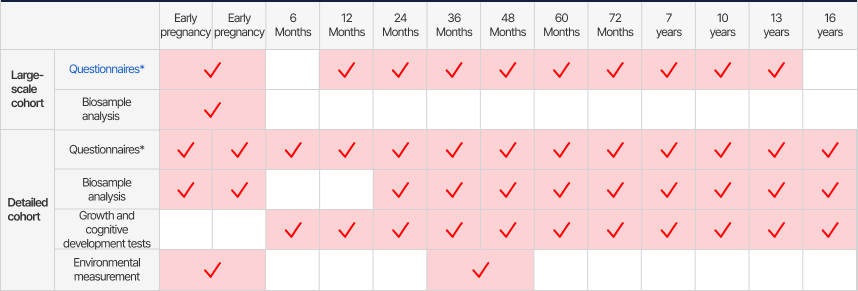
The study includes approximately 70,000 pregnant women and their newborns recruited nationwide between 2015 and 2021. Participants are enrolled in two cohorts: a large-scale cohort of 65,000 and a detailed cohort of 5,000. The study continuously monitors children’s environmental health and development. Participants receive a small token of appreciation for each survey participation.
Study Procedures
How is the Ko-CHENS Study Conducted?The Ko-CHENS study includes a range of comprehensive assessments, such as:
- Environmental exposure questionnaires
- Collection and analysis of biospecimens (blood and urine)
- Physical growth and cognitive development evaluations
- Indoor environmental and personal exposure measurements
- Clinical assessments (e.g., skin prick tests and lung function tests)
Utilization of Study Results
How are the findings from Ko-CHENS used?-

The personal information and biospecimens provided are utilized to analyze environmental exposures and monitor health outcomes, including linkage with national big data sources. These efforts aim to identify associations between environmental risk factors and environmentally related diseases.
-

The study also aims to raise public awareness among parents and communities about common environmental hazards encountered in daily life and to promote healthy practices for children.
-

Ultimately, the insights gained are intended to help establish a prevention-oriented environmental health management system.
Big-CHENS: Linkage of database from:
- National Health Insurance Service(prescriptions, etc.) - Statistics Korea(birth records etc.) - Ministry of Education(student health examination data, etc.)